
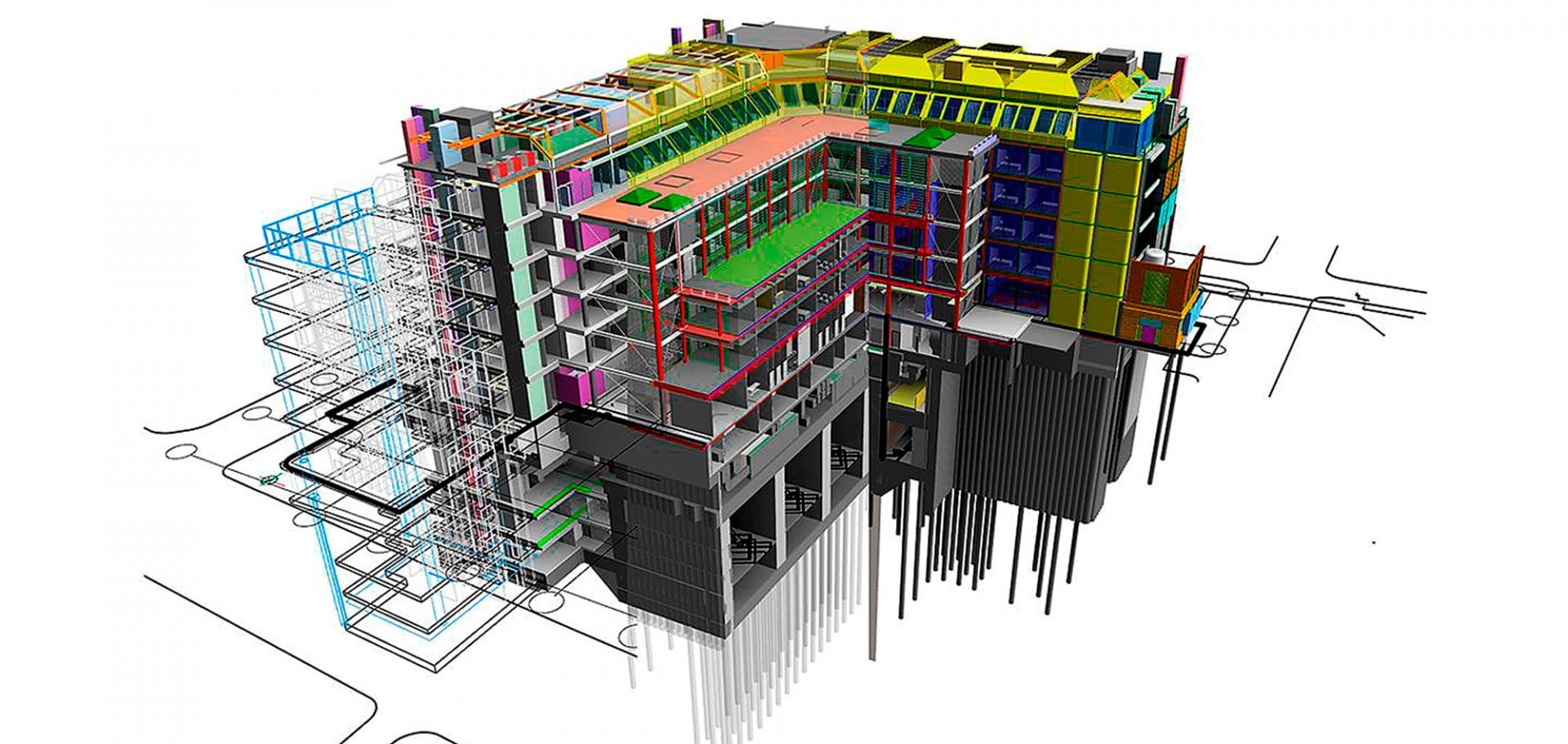
Building Information Modeling has quietly become the operating system of commercial architecture — and dealership design is no exception. What started as a coordination tool has evolved into the platform where design intent, engineering data, cost modeling, and construction sequencing all live in one place.
A modern BIM model is more than a 3D drawing. Every wall carries its material properties, every fixture its cost and installation requirements, every system its coordination points. The result: fewer surprises in construction, tighter budgets, faster permit cycles, and a project record that stays useful long after opening day.
For dealership design specifically, BIM handles the complexity that automotive retail projects carry — brand-standard compliance across dozens of specifications, MEP coordination for service bays, structural requirements for showroom loads, signage integration, brand element placement — as an integrated model, not as isolated documents that need to be manually reconciled.
In the US commercial architecture market, BIM adoption has passed the tipping point. The GSA has required BIM on federal projects since 2007. Most major architect-of-record firms in commercial retail now design in BIM by default. Autodesk Forma (formerly Autodesk BIM 360 and Construction Cloud) and equivalent collaboration platforms have become industry infrastructure. For an OEM or dealer group, the question is no longer whether their design partner uses BIM — it's how deeply BIM is integrated into their process.
VC ONE built its BIM practice as an integrated system across offices in Brazil, the United States, and Argentina. Custom BIM libraries codify the brand standards for the OEMs we work with. Internal design standards ensure model consistency across projects. A dedicated BIM management structure keeps quality high and knowledge shared as our team scales.
The impact shows up in delivery. The BYD dealership standard for South America was developed entirely in Revit, from concept through construction documentation. That single-model approach compressed the design cycle, tightened cost predictability, and delivered a network of dealerships that hold to the brand standard with the precision brand compliance demands.
BIM is not a differentiator on its own anymore — it's baseline infrastructure. What differentiates design practices is what they do with it: how deeply the brand standards are encoded, how tightly the model integrates with construction reality, how much intelligence gets built into every decision before ground is broken.
For dealership design at scale, that difference translates directly to timeline, budget, and network consistency.